DON’T LOOK UP – Review

(L to R) JENNIFER LAWRENCE as KATE DIBIASKY, LEONARDO DICAPRIO as DR. RANDALL MINDY, in DON’T LOOK UP. Photo credit: NIKO TAVERNISE/NETFLIX © 2021

What if the world did not respond the way it always does in every disaster movie to an impending doomsday invasion, meteor or – comet? What if the real world faced a giant “planet-killer” comet on a collision course with Earth? Would they come together to save the planet, like they always do in the movies? That is the question Oscar-winning director/writer Adam McKay (THE BIG SHORT) asks in his satiric comedy DON’T LOOK UP.

The comedy features a top-tier cast, with Leonardo DiCaprio as Dr. Randall Mindy, an astronomy professor at a Midwestern university, whose graduate student Kate Dibiasky (Jennifer Lawrence) discovers the giant comet. When Dr. Mindy figures out the comet’s terrifying trajectory, a deadly collision course with Earth, the pair set out to alert the federal government about the threat. The cast includes Meryl Streep as President Orleans, Jonah Hill as her Chief of Staff/son, Cate Blanchett as the co-host of a TV talk show with Tyler Perry as her co-host, Mark Rylance as a quirky tech billionaire who seems to have Asperger’s, Ron Perlman as a gung-ho former military hero, plus Timothée Chalamet, Ariana Grande and more.

DON’T LOOK UP is humor in the vein of DR. STRANGELOVE with a side of IDIOCRACY and a modern media slant, but with a bigger cast of idiots and hence more potential for things to go wrong. This satire is an equal opportunity ridiculer, taking swipes at all targets with range, from inarticulate scientists who can’t make a dire situation clear, to politicians wanting to use impending disaster to improve their party’s chances in the mid-term elections, to media talkers more enamored with the “hot” scientist’s good looks than his heated message, to political forces just denying facts and urging people to “don’t look up.” In DR STRANGELOVE, at least they could agree on the problem (well, mostly). In DON’T LOOK UP, as the title implies, denial abounds.

There are plenty of laugh-out-loud moments in this satiric comedy. Both DiCaprio and Lawrence are excellent as the alarmed scientists, increasingly frustrated that they message is not being taken seriously. The pair find a key ally in their effort to get something done to avert worldwide destruction in Rob Morgan’s Dr. Oglethorpe, a scientist at the Planetary Defense Coordination Office, a real NASA agency tasked with watching out for extra-terrestrial threats like this comet, as the film notes. Oglethorpe quickly arranges a meeting with the President for the two scientists, who are then sworn to secrecy and whisked away on a military transport jet to D.C. But once in the White House, they find themselves stuck waiting in a hallway, while President Orleans (Meryl Streep) deals with “more pressing” problems. After all, the comet isn’t going to hit the Earth for another six months.

Once the astronomers meet with the President and her Chief of Staff, (a very funny Jonah Hill), who also happens to be her son and occasionally slips up by calling her “mom,” things do not go well. Their “sky is falling” message is met with eye-rolling, and pressure to say the chance of a planet-killing direct hit by the enormous comet is less than the 100% the scientist insist on. The President’s focus is more on making the threat look less certain for PR reasons than finding a way to deflect the comet and avoid the planet’s destruction. No action is decided on, the White House will assess, and the scientists are instructed to keep their discovery secret in the meanwhile.

They don’t, thanks to the quick work by their ally Oglethorpe, who gets them on a morning talk show, The Daily Rip. But the happy-talk co-hosts, played marvelously by Cate Blanchett and Tyler Perry, are focused on finding the lighter side of this impending doom and on the good-looking professor. When Jennifer Lawrence’s the graduate student loses patience with them, her outburst does not play well on social media.

With the information revealed, the White House decides doing something about the comet might play well in the mid-term elections and the whole media/political circus gets rolling. Eventually, the President brings in a retired military hero, played by a blustering Ron Perlman, to head an mission to address the problem, and later a quirky tech billionaire, played with chilling style and the world’s whitest smile by Mark Rylance, who has another, profitable idea. Forces line up on either side of an “issue” that isn’t one.

Rylance’s performance is one of the stand-outs in this comedy, particularly in a tense scene with DiCaprio, where the astronomer tries to persuade the businessman to accept the input of expert scientists in finding a solution, only to be buried in a recital of the chillingly detailed personal information on the scientist that the ego-driven billionaire has collected on him, although it is irrelevant to the situation.

While the laugh-out-loud moments are plentiful, some might find its broad swipes on all sides too obvious, no matter how true they may be. The comedy draws parallels to some issues and takes aim at even more, and it is that broad focus that is a bit of a problem. While DR STRANGELOVE is focused on a single topic, nuclear war, DON’T LOOK UP can’t always maintain a single focus as it takes aim at host of problems that prevent the world coming together to solve a global threat. Bouncing from one example of self-destructive idiocy to another as it lands comic bombs, it diffuses its central focus. It is a flaw that makes this well-intentioned, talent-packed satire less the direct mocking hit it should be, despite its moments of gold and strong comic performances.

DON’T LOOK UP opens Friday, Dec. 10, in theaters, and debuts on Netflix on Dec. 25.

RATING: 3.5 out of 4 stars

GREENLAND – Review

You can count the days on one hand now. Less than a week before the biggest holiday on the calendar, the one that brings families together (most years, now…). Yes, Christmas unites families as does imminent disaster (as the frequent lockdowns of the pandemic have proven). But what if we’re talking about mere hours, rather than these extended quarantine periods? Could you somehow set aside everything (conflicts, distance) to fight the panicked throngs and get your loved ones to a place of somewhat uncertain safety? That’s the challenge facing the Garrity’s in this Earth-shaking (literally) new dramatic thriller. Perhaps their only chance of survival exists across the Atlantic in GREENLAND.

John Garrity (Gerard Butler) toils as a construction exec in Atlanta GA. His ability to leave the site early rarely happens, but he’s hosting a big neighborhood BBQ/ watch party. But what are they watching? Is it a sporting event? No, they’ll be looking at the news reports as the much-publicized Clarke Comet finally enters our planet’s atmosphere. It’s generally thought that most of the comet will evaporate, but it’ll hopefully be a pretty light show. When John returns home we learn that his marriage to Allison (Morena Baccarin) is strained, but they’re putting on a happy face for their friends and their sweet seven-year-old son Nathan (Roger Dale Floyd). On a shopping trip for last-minute supplies, the boys are surprised by a fleet of jets zooming overhead. In the store, the alarm setting from John’s phone begins blaring. It’s a message from the NSA saying that he, his wife, and son should pack a bag and report to the nearest air force base for emergency relocation. He and Nathan return home just in time for the first bit of the comet’s debris to hit. John is shocked when its force sends out a shock wave that knocks him to the ground and breaks the house’s windows. It seems that the government and media were downplaying the danger of Clarke. The trio quickly packs their bags and jump into their SUV. Of course, it’s a madhouse at the base as a mob tries to get past the gate. Luckily John shows the guards the text message code on his phone. Inside the hanger, they discover that Nathan’s diabetes meds were left in the car. But as John goes to retrieve them, the supervisors learn of the child’s ailment. Those with medical conditions are not allowed on planes. As the arrival of the big chunk of Clarke known as the “planet killer” nears, John is separated from his wife and son. Can they reunite and make the long trek to her father’s home in Knoxville in time. And could there be a way for them to find perhaps the only safe haven from the world’s end?

The most impressive skill set that the main cast utilizes is the ability to sustain a consistent level of hysteria in many of the story’s most harrowing sequences. In fact, this is the best work in a while for Butler, who has been bouncing between mediocre to near-unwatchable “rom-coms” and action “potboilers” for much of the previous decade. He makes John Garrity a believable “everyman” who is dumbfounded by the government’s efforts to “scoop him up”. Later we see his torment at having to ignore the pleas of his neighbors as he dashes away. And when he must defend himself (and he really tries to talk things out) we see the shock in his eyes as the violent encounter takes a fatal turn. Butler shows us how John pushes past the extreme trauma and exhaustion to hold on to his family. Baccarin is an equal partner, trying to comprehend this disruption to their lives, then switching into “mama Grizzly” mode to protect her child. Like her hubby, she nearly gives in to grief and despair but never lets that flicker of hope get extinguished. Floyd is a most endearing moppet, who conveys Nathan’s fears but is able to summon up his bravery in several harrowing scenes. A few of those are with David Denman and Hope Davis who are very effective as a helpful couple that might be hiding some truly evil intentions. A very pleasant surprise saved for the final act is the casting of the underused Scott Glenn as the patriarch that’s tough with his son-in-law (John knows that he’s “got it coming”) and tender with his grandson. He can’t stop a comet, but his Dale could protect his “kin” against almost anything.

Director Ric Roman Waugh (a former stuntman) does a terrific job giving us a sense of the scope of the disaster, while not losing focus on the intimate tale of a family slowly healing as they fight to survive. Thanks no doubt to some subtle CGI trickery, we can feel as though we’re right in the middle of the uncontrollable mobs that respect nothing in their path. The fairly tight script by Chris Sparling has a bit of an episodic feel or (for your classic film buff) the beats of a movie serial with the Garrity clan facing another new perilous challenge at the end of every “chapter” ( or in this feature film’s case every ten or twelve minutes). The stunt performers are top-notch, from a car chase through a packed highway to a punishing attack from above by hot comet chunks (a constant stream of flaming softballs). Overall the flick delivers what it promises in nail-biting, world-ending thrills, and suspense. After nearly nine months of stress, it may be comforting to see what could happen if things got a whole lot worse. It doesn’t quite have the nostalgic vibe of those 70s catastrophe classics (the Irwin Allen flicks or the AIRPORT series), but if you’re in the need of a ride that’ll keep you on the edge of your sofa (or recliner) than book a trip to GREENLAND.

2.5 Out of 4

GREENLAND is available as a Video-On-Demand via most streaming apps and platforms beginning Friday, December 18, 2020.

WAMG Talks To Sam Esmail: COMET

COMET 5COMET 5COMET 5 copy

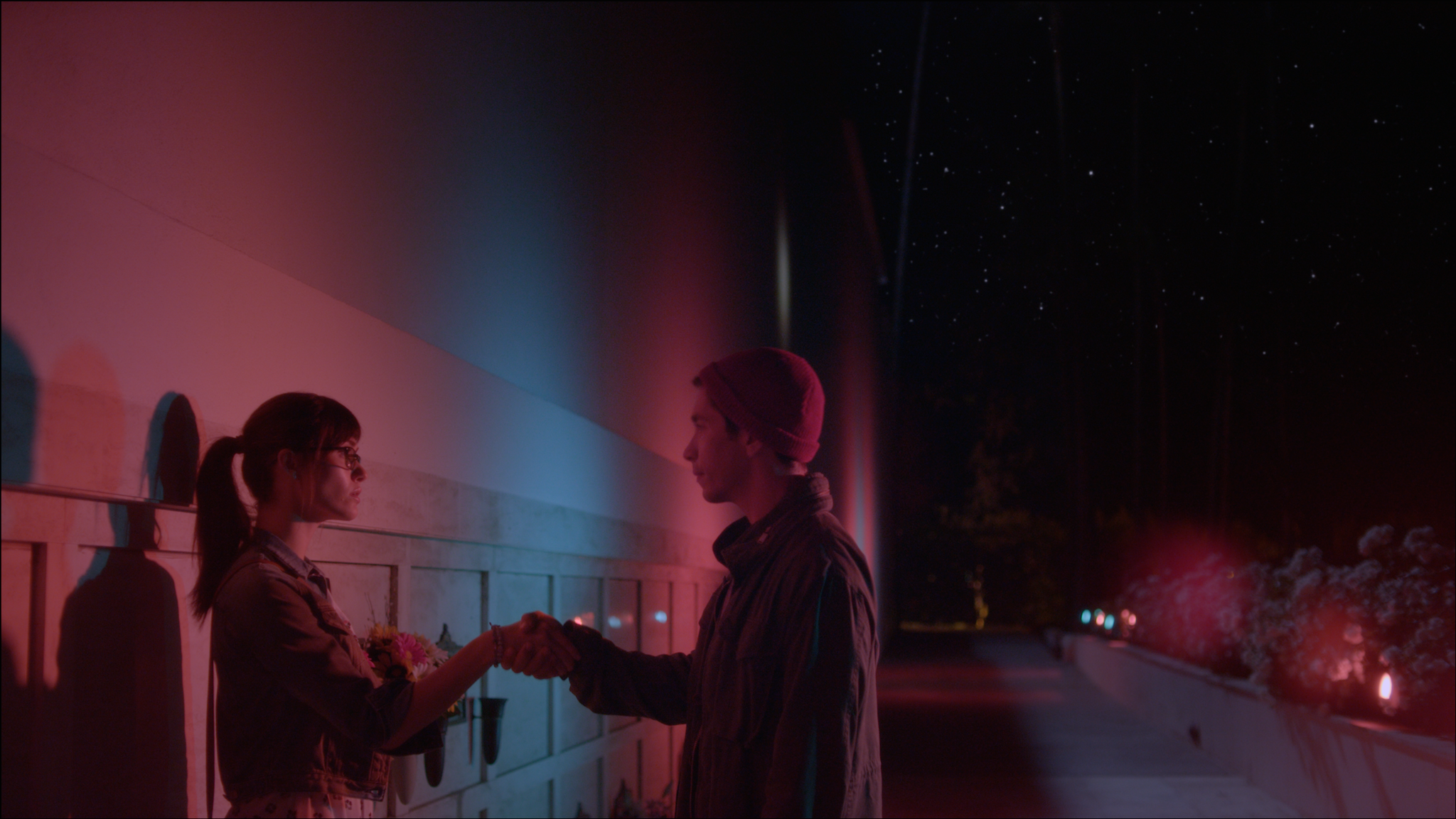
Hurtling back and forth in time over six years of a passionate, complicated relationship, COMET is a high-style love story crackling  with brilliant repartee, and simmering with true feeling. Last week, the film made its premiere at the Los Angeles Film Festival. I recently spoke with director Sam Esmail about writing and directing his first feature, shooting in the Hollywood Forever cemetery, and working with Emmy Rossum and Justin Long. Check it out below!

Emmy Rossum is the bright, skeptical Kimberly, and Justin Long is the tightly wound Dell.  They first meet in a random encounter at Hollywood Forever, where they’ve both come to watch a meteor shower. It’s the start of a romantic roller coaster ride that leaps from a Paris tryst to a squabble in New York to the Hollywood Hills, taking risky and unexpected emotional turns with daredevil aplomb.

COMET 1 copy

As a first time writer/director (which I would have never guessed by watching this) how was your experience wearing both hats on this project?

Sam Esmail : I think it’s easier being the writer when you’re directing. I’m always rewriting and polishing as the first day of shooting approaches, and the changes are almost always informed by the actors and production. Since I had a group of talented creative heads, their input on how they saw a scene would oftentimes lead to a rewrite. Knowing the characters and the world so well, I was able to change and adapt quickly as better ideas came to the surface. It’s such a great head start for a director, I think.

Your cinematographer mentioned that the hardest shots to pull off were the cemetery scenes. As a director, what were the most challenging scenes for you?

Sam Esmail : I would have to agree with Eric on that. I’m a night owl. I can stay up until whenever. But, in this case it was particularly rough because it was the last week of the shoot and the cast and crew didn’t really have time to adjust after doing tough, long days. So you’re not only battling fatigue but light as well, because we didn’t have twelve hours of night, we had nine– one of the minuses of shooting in the summer.

COMET 2 copy

Speaking of your cinematographer… there is such a great tone between the timeline jumps in this film. How did you and your cinematographer work together to blend the scenes/jumps?

Sam Esmail : We planned meticulously. I am not one of those directors that likes to hand the operator the camera and find the shot on the day. I prefer to compose everything and make adjustments on set when needed. Since Eric owned the Red, we actually went to all the locations beforehand and took stills– that basically became our storyboard. From there, we could piece together shots that would cut from time period to time period, and that would in turn influence our framing, movement and especially lighting since we had a lot of contrast between the sections. During the shoot, I was very stubborn about changing anything because I feared the domino effect it would have, namely potentially causing transitions not to blend in the right way. But you can’t be too stubborn, especially if what you planned feels unnatural to the actors. I remember specifically on the train set there was a scene we blocked and storyboarded that felt very stiff and boring; Emmy and Justin came up with a great idea that immediately brought life to it. It was a no-brainer, we had to adjust and then worry about how it would effect other scenes later. But on the flip side, there was a setup against the wall on the cemetery that we planned that would cost us a huge chunk of time to light. We could have easily changed the shot to save time, but it wasn’t nearly as good and, in my opinion, would have adversely effected the feel of that scene. So, you have to pick your times to stay firm and your times to adjust– because the film had these interlocking pieces, you were never allowed to be lazy and just pick what was fastest.

You have an incredible cast, especially with Emmy and Justin. With them being such seasoned actors, was there anything you learned from them on set?

Sam Esmail : The biggest thing is letting them be a part of the rewrite process. I loved rehearsing and rewriting the script based on the sound of their reads, the flow of their back and forth, and, most importantly, their feedback. They were really my partners on the script. Lots of great detail and character insight came from our rehearsal/collaborations. What was great about working with them was a lot of the work was done before the shoot. When it came time to do the scene, they were so prepared that we could always jump right in. Also, a great trick I learned from Emmy was to not cut after a take– just quickly go again and do a series within a take. The energy level stays up and the performances become more and more interesting.

COMET 3 copy

What was your approach to shooting this film, since there are multiple stages to their relationship?

Sam Esmail : I reordered the script so that it was entirely chronological; each section was strung out together as essentially one long scene. It just made everything easier to understand, especially for Emmy and Justin. Because we preplanned the different transitions, we knew we could live inside this “linear bubble” during the shoot and remind ourselves of the moments that we needed to address for time jumps. Sometimes, we’d even shoot scenes or pieces of scenes from one time period in another, just to experiment around or cover ourselves. It was definitely confusing at times– we had to often triple check with the script supervisor as to “when” we were.

COMET 4 copy

*COMET made its premiere at the LOS ANGELES FILM FESTIVAL. As of June 24th, the film has yet to have U.S. distribution.