THE BEACH BOYS (2024) – Review

Kicking off the start of Summer with the big Memorial Day weekend, a new documentary poses the question: What’s the “go-to” music for this season? Well, for the past 63 years, it’s been these pop icons out of Hawthorne, California, of course. Their signature songs invoke memories of ocean waves hitting the sand as eager athletes run through the foam with their trusty boards. Interestingly only one member of the original band surfed, though when watching a blonde adonis catching a “tasty wave”, you automatically, in your head, recall the sweet infectious harmonies of THE BEACH BOYS.

After opening with glorious footage of an electric 1975 outdoor concert (naturally in the bright Summer sun), the doc springs back 15 or so years to the modest suburban home on 119th Street when the eldest Wilson brother Brian became fascinated by the careful vocal craftsmanship of the Four Freshmen along with other musical acts. That included rock and roll and the emerging sound of the surfing-inspired instramentals. He brought in his younger brothers, Carl and Dennis, and later enlisted Mike Love and schoolmates Al Jardine and David Marks to record songs on Brian’s new reel-to-reel recorder as the “”Pembertones. Father Murry Wilson took their song “Surfin'” to the Candix label, and the disc was released sporting a new moniker for the guys, the Beach Boys. They soon went from regional radio staples to the top of the Billboard charts when they signed with Capitol Records, scoring with odes to fun at the seashore like “Surfin Safari” and “Surfin’ U.S.A.”. The film charts their meteoric rise while chronicling the many changes to the performing roster of musicians. When David returned, Brian tired of performing live which ushered in performers like record producer Bruce Johnston, guitar legend Gelen Campbell, and eventually Blondie Chaplin and Ricky Fataar. The film also touches on the conflicts, from the abrasive tirades of Murry to the wild antics of Dennis and his brush with the Manson family. Yet somehow the music’s legacy grew in stature which culminates in a remarkable reunion with the survivors on the location of one of their most famous album covers.

This film marks another excellent feature documentary from two veteran directors of the “music doc” genre, Frank Marshall (JAZZ FEST: A NEW ORLEANS STORY and THE BEE GEES: HOW DO YOU MEND A BROKEN HEART) and Thom Zimny (several Bruce Springsteen profiles along with Willie Nelson and Johnny Cash). They’ve assembled quite an exhaustive compilation of performance pieces from the past including TV shows ( a sketch with mop top wig-wearing Jack Benny and Bob Hope) and live concert shows (love the young ladies leaping on stage to tackle Mike Love), not to mention terrific archival interviews with the Wilsons and some collaborators (Campbell and members of the famed “Wrecking Crew”). We also get close-ups of Brian’s notepads of lyrics and a few audio clips made during recording sessions when a tipsy aggressive Murry rightly earned the ire of his sons. A few of the scandals are glossed over (the indulgences of Dennis and that scary association with Charlie I mentioned earlier), Brian’s shadowy reclusive years (the docudrama LOVE & MERCY tackles that in full), and the legal skirmishes between Brian and Mike. Oh, and there are some interesting new interviews done with folks like producer Don Was and artists Janelle Monae and Lindsey Buckingham along with the band. Even Brian’s first wife Marion is there with some great personal memories. And though they were initially rivals, Paul McCartney expresses his admiration for the group, And that all stems from that sound, those harmonies, and the giddy fun of those songs celebrating the carefree teenage days. Yes, celebration is the operative word, even as Brian shares the fate of Barry Gibb (in Marshall’s HBO doc) as the last brother, we see the power of music to heal as the now geriatric “Boys” gather on the sand for that warm gathering before the final fade-out. It’s truly an “Endless Summer” in this engaging and compelling portrait of “America’s band”, THE BEACH BOYS.

3.5 Out of 4

THE BEACH BOYS is now streaming on Disney+

THE HIGH NOTE – Review

So this weekend brings another new film that’s set in the world of “things we could do three months ago”. Last week it was world travel with Steve and Rob in THE TRIP TO GREECE along with Kristin and Sharon singing in a choral group in MILITARY WIVES. This week the “now verboten” activity in concert-going. Well, that’s really just a part of the flick’s story, but it’s a big part. There are several scenes with one of the characters filling big stadiums and amphitheaters, usually for “one-night-only” shows, and often not knowing the locale (“Good evening…um..where are we?”). Now the story’s main focus is not the chart-bustin’, seat-fillin’ superstar, but their lowly assistant, the “errand-runner” actually. We saw a bit of that in the recent A STAR IS BORN remake, to a lesser degree in the indie drama THE ASSISTANT, and as fodder for TV comedies like “Entourage” and “30 Rock”. And there was LATE NIGHT from last year, which, oddly enough, was from the same director as this flick. So, in this current effort, does she hit THE HIGH NOTE?

Much like the central character, this movie hits the ground running as we observe “star aide” Maggie (Dakota Johnson) embarking on several “morning missions” for her boss, pop diva Grace Davis (Tracee Ellis Ross). “Pick up this” “Grab that” until her now packed to the roof “seen better days” car arrives at the Davis mansion somewhere in Hollywood. In addition to the “pop diva”, Maggie must also deal with long-time, usually surly (oh, can he give the “stink-eye”) talent manager Jack (Ice Cube) and the “dim bulb” housekeeping supervisor Gail (June Diane Raphael), who seems to think that she’s a font of wisdom. Grace is at somewhat of a career “crossroad”. Should she keep playing big arenas around the globe, doing “one-nighters” and belting out the old familiar hits, or should she go with Jack’s idea to hook up with a Vegas casino to be an “artist in residence” and croon the same tunes in the same showroom for several months (maybe a year or two). But Maggie hopes to offer another alternate. In her precious “downtime” she’s been using new software and apps to give her standards a bold “new” sound without “drowning out” her still sharp vocals. Soon she’s got another “side gig” when she “meets cute” the owner of a produce chain, David Cliff (Kelvin Harrison Jr.) who is also quite the pop balladeer. Maybe Maggie can produce some songs with him, if she can keep things “professional” (a big challenge with the charming Cliff). But will this interfere with her work with Grace? Could she make “beautiful music” with both of them?

In a big break from the FIFTY SHADES trilogy, Johnson brings a low-key charm to her “everywoman” role as the often unappreciated Maggie. Her aide role is close to the classic “plate-spinner” act as she tries to keep track of Grace’s itinerary while trying to predict her abrupt mood changes while brushing aside those who would curry favor or exploit her. Johnson gives us the “vibe” that Maggie is forming a “hard shell”, putting on armor, while fretting over losing her own sense of empathy for others. Unfortunately her character is not as compelling or complex as Grace, played with a dramatic flourish by the commanding Ellis-Ross. Sure the comparisons to her famous mother Diana are evident, but Ellis-Ross resists the notion of turning her into a petulant, campy primadonna. The film only comes alive when she switches personas on a dime, from demanding dictator (at a party Maggie spits out a drink when caught in Grace’s icy stare), to gossipy gal pal, to the uncertain artiste, showing her vulnerability as she regrets past choices and faces an uncertain future, being a minority singer of a “certain age”. She’s paired with a great sparring partner, as Cube struts and growls as he presents his talent, but makes sure to get in every photo or video. At times they behave like an endearing but often bickering old married couple. Though he grumbles we know that Jack would do anything for his Grace. Like Johnson, Harrison tackles another real “change of pace” role, coming off his superb dramatic 2019 “one-two-punch” of LUCE and WAVES. His Davis is pure silky-smooth laid-back charm as he flits into Maggie’s orbit. And when he gets to the mike stand, she (and many others) will almost swoon at his charisma wrapped in some powerful “pipes”. As for the rest of the comic support team, Raphael is underutilized as the daft Gail, while Zoe Chao is a very funny encouraging roomie to Maggie. On the male side, veteran Bill Pullman strides in for the final act, while real-life tech music guru Diplo appears to be having a great time skewering his hipster image.

The aforementioned director, Nisha Ganatra, ably conveys the twirling hectic life of a professional “go-fer” in the opening scenes giving us a sparkling “city of dreams” in the often familiar California backdrops (plus Catalina Island looks idyllic in the final moments). And when we’re following in the bedazzling footsteps of Grace, the glow of superstardom is mesmerizing. Unfortunately, the script, from newcomer Flora Greeson, cuts away to the rather limp romantic subplot, along with lots of “sound mix” collages. The Maggie and David courtship fizzles (some chemistry clashes), as we wait…and wait… to get back to Grace and (gone for most of the middle hour) Jack. In the last half, much of the comedy lands with a clunk (and there are some very funny people on screen). And then, in the last few minutes, a twist/curve is sprung on the audience that’s both ludicrous (not in a comic sense) and frustrating, with characters making “off-kilter’ decisions just in order to provide some dramatic conflict. And despite tossing off bits of pop music trivia, and kissing pics of superstars that adorn the hallways of Capitol Records, Maggie never seems plausible as a musical mastermind. Ellis-Ross, on the other hand, feels like the “real deal” although we’re cheated on any full vocals until the near fade-out. Oh, her wardrobe from Jenny Eagan is worthy of a pop queen. Ultimately though, THE HIGH NOTE is one off-key backstage tune. And here comes the hook…

2 Out of 4

THE HIGH NOTE opens in select theatres and drive-ins. It is also available as a Video On Demand on most cable and satellite systems and is streaming on demand via most apps and platforms

HOW TO BUILD A GIRL – Review

So, who’s ready for a nostalgic hop across the pond? But really, after a couple of months lockdown, who’s not up for that? And what kind of nostalgia, any particular decade? Why let’s bounce back to the wild, weird 1990s. Oh really? Now I know how my folks felt when we went crazy for the 50’s back in the late 70s. But there’s one thing all those eras have in common: rock n’ roll, or the more encompassing “pop music”. Toss in lotsa’ family drama, some “coming of age” angst, and a smidgen of snoggin’ (well, romance is more apt) and you’ve got this flick’s recipe. Actually it’s more of an instructions guide, but don’t let the title lure you into thinking that it’s a reboot (or “re-imagining”) of the John Hughes teen fantasy WEIRD SCIENCE. Nope, that’s not the gist of this self-empowerment manual/journey that’s HOW TO BUILD A GIRL.

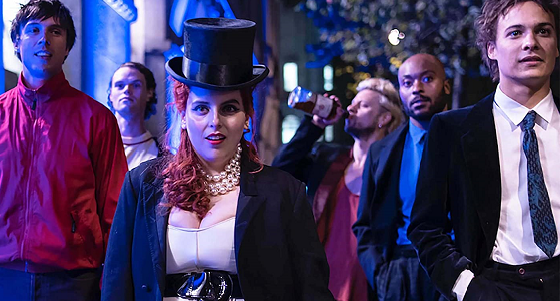
That title girl is fifteen-year-old high schooler Johanna Morrigan (Beanie Feldstein) who daydreams about the perfect boy that will change her life. Well, since that’s not going anywhere, she plots her own destiny as an aspiring writer, a big goal for someone growing up in a council estate in Wolverhampton. Dad Pat (Paddy Considine), an aspiring musician struggles to make ends meet on his disability benefits, while mum Angie (Sarah Solemani) is a near-zombie after recently birthing twins (at age 38). And Johanna has two brothers, grade-schooler Lupin (Stellan Powell) and a grade-ahead-of her Krissi (Laurie Kynaston), who’s also yearning for a boyfriend. After winning a writing competition, she makes a splash on a local TV morning “chat” show. Spurred on by the taped pictures on her bedroom wall of her idols and inspirations (they come to life when nobody’s around but her), Johanna sets her sights on becoming a rock music reviewer/journalist for the glossy “fanzine” called “Disc & Music Echo” (DME). Most of the London bullpen scoffs at her, but one staffer (Frank Dillane) convinces the editor to give her a chance. But first, Johanna must “make herself over”, create a persona. Dyeing her hair a rich red magenta and donning an outfit that resembles DC comics “super-magician” Zatanna (top hat, tails, and fishnet stockings), she adopts the “pen name” Dolly Wilde. DME gets lots of positive feedback on her piece, so they give her a showcase assignment, a one-on-one interview/profile of pop sensation John Kite (Alfie Allen). The two make an emotional connection resulting in a fawning “fan-girl” puff piece that nearly gets her fired. To keep the money flowing Johanna decides to turn Dolly into an acerbic, name-calling, “poison pen” critic, which earns her more acclaim and cash. But what happens when the character she’s created starts to take over? Will the demonic diva Dolly obliterate the sweet jovial Johanna? Or will she resist the siren call of fame to stay true to herself?

After sharing the screen in recent teen “drama-dies” like LADY BIRD and BOOKSMART, Feldstein gets the chance to carry a film on her own talents. And she does for the most part, despite the too obvious story mechanics (and a whispy, breathy accent). In the opening sequences, she’s got an effervescent energy, lighting up the screen as she glides from home to school, then soaring into the London DME offices like a stealth bomber. Her wide-eyed optimism for that first half makes the transition to the dark side in the second act a bit too difficult to accept. Luckily she has excellent acting support, particularly from Kynaston who deftly morphs from a delighted cheerleader ( a spin on the best gay pal of cliched “rom-coms”) to the true confidant who will deliver that much-needed “wake-up call” to get her back on track. At one point he delivers a monologue about his very closeted beau that is heart-wrenching. Considine is an endearing delight as the playful patriarch who barely stays on the “straight and narrow”, wanting to care for his family but still holding to a tiny bit of his rock n’ roll dreams. A good deal of the drama is handled deftly by Solemani, whose Angie adores her kids but fights the energy-draining effects of her late in life twins. Though her eyes are nearly always at “half-mast” they’re filled with affection. As for Dolly’s encounters, Allen is quite compelling as the somewhat jaded pop performer whose muse is awakened thanks to her open nature. Aside from her family, Johanna has the strongest emotional connection with him. Plus there are some terrific cameos from many talented British comic vets. Chris O’Dowd is hilariously awkward as the stiff TV host blindsided by Johanna’s studio coup. Joanna Scanlan is superb as Johanna’s tough but encouraging school writing teacher. Emma Thompson shows up close to the finale as another mentor who guides with just the right hint of snark. Best of all is the “who’s who” wall of idols in Johanna’s bedroom including some inspired pairings from Michael Sheen as Freud to Lucy Punch as Sylvia Plath and Sharon Hogan from TV’s “Catastrophe” as a very hard-edged Jo March.

A nice blend of whimsey and satire is achieved in the first half-hour thanks to the assured direction by TV vet Coky Giedroyc and the screenplay by Caitlin Moran, based on her novel. This is especially true as Johanna literally fills her backyard with every type of fantasy “dream boy”. But things change with the introduction of the Dolly personality and the story starts to stray into familiar “morality lesson” terittory. It becomes more jarring as Dolly almost transforms into Johanna’s “Ms. Hyde”, sloshing booze, and dismissing her family. This is driven home by the film’s most graphic sequence (no doubt earning that R rating) as Dolly cruelly and in great detail, relates the laundry list of sex partners (and positions) to her frustrated older brother. It’s a lurid montage that seems so out of place in the story of a teen following her dreams. We’ve seen that downward spiral in too many young adult pop tales. The same could be said for the interchangeable settings (I almost expected the family from last year’s BLINDED BY THE LIGHT to be next door) which made the era hard to identify (there are no cell phones so is it the 80s, but there are still cassettes, so is it…). Plus the delightful “talking wall of fame” is completely forgotten for the middle hour. Feldstein’s Johanna is (for much of the tale) a compelling heroine but HOW TO BUILD A GIRL stumbles and fumbles toward the task’s completion.

2 Out of 4

HOW TO BUILD A GIRL opens in select drive-ins across the country and is available as a Video On Demand through cable and satellite systems and can be purchased through most streaming platforms