In honor of the opening of the film BURLESQUE, starring Cher, Christina Aguilera and Stanley Tucci, the Movie Geeks are presenting what we feel are the best motion picture musicals.
Honorable Mention: MARY POPPINS

“Practically Perfect in Every Way”, this is how the incomparably magical nanny Mary Poppins describes herself with nary a boastful smirk on a revealing tape measure in the still-charming 1964 Disney classic musical set in post-Victorian London circa 1910. MARY POPPINS is the first movie I can remember seeing in a theater as a child I still feel genuine warmth about this movie as an adult. Such was the impact of Julie Andrews in her big screen debut, as she epitomizes the title character with equal quantities of starch and sugar. There are so many delightful scenes in MARY POPPINS that it’s hard to choose which to highlight, though one of the best ones has to be the fantasy animated sequence where Bert, as played by the incomparable Dick Van Dyke dances with the penguins. MARY POPPINS is still one of the best family-oriented films to come out of Hollywood.
10. ROCKY HORROR PICTURE SHOW

THE ROCKY HORROR PICTURE SHOW is the essential B-movie: cheesy script, bad special effects, and odd costumes, characters, and plot lines. But despite the budget, it is a great movie. The songs are excellent, and although odd and cheesy, the script is solid. The quality of acting is strong across the board but when Tim Curry makes his entrance as Frank N Furter, you can’t take your eyes off one of musical cinema’s great characters. It’s become the definition of a midnight cult film and begs to be seen, like it is at the Tivoli theater in ST. Louis every October, with performers on stage and the audience joining in a collective send-up. It’s pure escapism so open your mind and give yourself over to absolute pleasure for THE ROCKY HORROR PICTURE SHOW never grows old.
9. CHICAGO

Seems as though every four or five years entertainment reviewers and reporters bemoan the death of the movie musical. Shortly after, a film is released that injects life into the “dead” genre. Such is the case of Rob Marhsall’s 2002 big screen adaptation of the Broadway smash, CHICAGO. The story of murder and fame was originally a 1920’s non-musical play, then a silent film, followed by a sound version(Ginger Rogers as ROXIE HART) in 1942 and finally become a stage musical in the 1970’s with Gwen Verdon and Chita Rivera. After a hit stage revival in the 1990’s the story kicked around Hollywood again until Marshall and screenwriter Bill Condon hit upon a way of adapting it for modern audiences. The big song and dance numbers would be fantasies in the mind of Roxie. And what glorious fantasies! Roxie sees herself taking over from Velma Kelly on “All That Jazz”. Queen Latifah as women’s lock-up matron “Momma” Morton” belts out “When You’re Good to Momma” in a smokey jazz club. The gals recreate the 70’s Bob Fosse choreography during “The Cell Block Tango”. Catherine Zeta Jones shows off the skills that earned her honors as the best tap dancer in Wales(and an Oscar) as she tries to sell Roxie on the idea of the two of them going on stage. Richard Gere joins the fun as the showboating defence attorney Billy Flynn and belts out one of Kander and Ebb’s (CABARET) signature tunes, “Razzle Dazzle”. The big numbers are superb, but what may resonate most with audiences is that original story from the 20’s. In the era of reality TV and tabloid stars, Roxie’s quest to become famous by any means seems more relevant than ever. Movie audiences(and Academy members) responded enthusiastically to this big, brassy musical and it took home six Oscars including Best Picture. Not bad for a “dead” genre.
8. LITTLE SHOP OF HORRORS

To this day, I find it difficult to imagine these words would pass through my lips… but, Frank Oz out did Roger Corman with a musical. Corman’s classic was a dark comedy, but what oz managed to do was to bring Little Shop to the forefront, maintaining the dark humor while adding the whimsical Broadway element. Combined with a somewhat recognizable cast for the time, the film became a cult classic, not on par with but akin to Rocky Horror Picture Show. Audrey was unforgettable, enjoyable and frightening, while the cast of mostly actors inexperienced in the musical genre, pulled off this feat with fantastic results. “Feed me, Seymour!” I want more!
7. CABARET

Prepare yourself. this will be the ONLY time you hear me say these words… Liza Minelli is brilliant [in CABARET.] Bob Fosse’s film adaptation of the Broadway musical is extraordinary on every level. The story of Sally Bowles, a burlesque entertainer in the midst of the Nazi party’s rise to power, comes to vivid life on screen. CABARET is one of those rare musicals that doesn’t feel like a musical, but maintains the magic therein. The audience is not bludgeoned repeatedly with hokey, cheesy songs that show up out of the blue, detracting from a wonderful story. Fosse was remarkably successful at conveying a sense of realism combined with the Broadway show spectacle.
6. WEST SIDE STORY

Based on the classic tragedy of Romeo and Juliet, West Side Story tells of the ill-fated romance between Tony and Maria, young lovers each associated with gangs at war with each other (the Sharks and the Jets). Everyone is familiar with the story, but what I really find interesting is some of the behind-the-scenes facts that many people don’t know.First of all, it needs to be pointed out that West Side Story was nominated for 11 Academy Awards and won 10, including Best Picture and Best Supporting Actor and Actress (Rita Moreno and George Chakiris). It still holds the record for most Oscars won by a musical.My other favorite trivia about West Side Story is all the actors in Hollywood that were either considered or campaigned for the roles of star-crossed lovers Tony and Maria. Elvis Presley was originally approached for Tony. However, his manager, Colonel Tom Parker strongly believed the role to be wrong for Elvis and made him decline in favor of other movie musicals. Several Hollywood men auditioned for the part, including Warren Beatty, Tab Hunter, Anthony Perkins, Burt Reynolds, Troy Donahue, Bobby Darin, Richard Chamberlain and Dennis Hopper. Most were deemed too old and the part eventually went to former child star Richard Beymer.Jill St. John, Audrey Hepburn, Diane Baker, Valerie Harper, Elizabeth Ashley and Suzanne Pleshette were among the many actresses who lobbied for the role of Maria. However, Hepburn later withdrew because she became pregnant. The producers had not originally thought of Natalie Wood for the role of Maria. She was filming Splendor in the Grass with Warren Beatty and was romantically involved with him off-screen. When Beatty went to screen test for the role of Tony, Wood read opposite him as Maria as a favor because she had been practicing with him. The producers fell in love with the idea of Wood as Maria but did not cast Beatty.Both actors Natalie Wood and Richard Beymer tried to do their own singing for the movie, but their voices were ultimately deemed to be too unrefined, and they were overdubbed by Jimmy Bryant and Marni Nixon, respectively. Wood’s contract stated that she would pre-record all her songs. When Wood struggled with the challenging soprano role her voice was blended with Marni Nixon’s. Natalie sang the lower portions and Marni’s provided the higher vocals. During production, she was led to believe that these versions would be used (with Wood singing the majority of the vocals), although music supervisors Saul Chaplin and Johnny Green had already decided her singing voice would later be completely dubbed by Marni Nixon.
5. FIDDLER ON THE ROOF

Filled with such memorable songs as “If I Were A Rich Man,” “Tradition,” “Matchmaker,” and “Sunrise, Sunset” FIDDLER ON THE ROOF is #5 on our list. The Norman Jewison directed musical centers on a poor milkman, Tevye (Topol), and his Jewish family living in the town of Anatevka, in Tsarist Russia, in 1905. Tevye’s focus is on his three daughters and who they’ll marry. The original Broadway production of the show, which opened in 1964, was the first run of a musical in history to surpass the 3,000 performance mark and held the record for the longest-running Broadway musical for almost 10 years. At the time, the decision to cast Topol, instead of Zero Mostel, as Tevye was a somewhat controversial one, as the role had originated with Mostel and he had made it famous. Surrounded by a supporting cast of Norma Crane, Leonard Frey, Molly Picon and Paul Michael Glaser, the robust Topol was only in his mid-thirties when he performed the role of an older Tevye. The film won three Academy Awards and two Golden Globes in 1971. It won Oscars for Best Song Score Adaptation, Best Cinematography, and Best Sound – including one for arranger-conductor John Williams. The cast looks realistically cold throughout seeing as it was lensed in Croatia: in Mala Gorica, Lekenik, and Zagreb. One of the more memorable scenes happens during the opening credits. While constantly talking to the audience (and God), Tevye sits outside his house explaining the importance of tradition and stability, otherwise his life would be like a FIDDLER ON THE ROOF.
4. THE WIZARD OF OZ

Ok… so, this one has a special place in my heart. (Melissa here). I grew up with THE WIZARD OF OZ, and I know you are all thinking the same thing… but did your mother have an entire room dedicated to it??? Filled with costumes from MGM on mannequins, or a cairn terrier named Toto? Oh good, I win! I can recite this movie the entire way through. Talk about a remarkable film that was adapted from books. Judy Garland, Ray Bolger, Bert Lahr, Jack Haley, Margaret Hamilton… they are all memorable characters that make you forget that they are actors. Sure, the silver make up was far from safe, and you can see the crew running around in the forest if you look closely, but it is still a timeless piece of history! My favorite scene was actually cut, but it can be seen in the extras… It’s the Jitterbug number. I wish they would have left it in, but it didn’t do much for the film as a whole.This movie still captures the hearts of little girls who are waiting to get swept away to Oz (that is, once they get over their fear of the witch!).
3. MOULIN ROUGE

In MOULIN ROUGE, director Baz Luhrmann combined the commercial (using modern music and a surprisingly heavy dose of comedy) with the artistic (the heavily theatrical stylings and loaded emotional content) to create a definitive pop-opera that was both unhinged and brilliant. With CG-rollercoaster shots through Paris, amazing production design and about as much edits you can fit into a two-hour film without driving your audience fully insane MOULIN ROUGE was a visual feast every second of its running time. Luhrmann used many different types of music and has everything from Diamonds Are a Girl’s Best Friend to Material Girl to Smells Like Teen Spirit to FatBoy Slim’s loose interpretation of The CanCan all in the first 15 minutes! Nicole Kidman was at the top her game as Satine and MOULIN ROUGE had great supporting work from Jim Broadbent and John Leguizamo.
2. THE SOUND OF MUSIC

SOUND OF MUSIC is #2 on our top ten musical favorites this week. I love this movie and I have loved it since I first saw it as a child. The film is based loosely on the life of the Von Trapp family the summer before the start of World War II. The mother has died and the father is trying to find a governess to care for his 7 children. Captain Von Trapp believes that the only way to maintain discipline is to run the house with strict rules. Maria has other thoughts on how to control the children. The household is transformed by Maria, and so is the audience. One great song after another is performed. The musical score is by Rogers and Hammerstein (you can’t possibly go wrong there). Put together their brilliant music and the talents of Julie Andrews, Christopher Plummer and the rest of the cast and the film is wonderful. The film won 5 Oscar Awards; Best Director, Best Film Editing, Best Music, Best Sound and Best Picture.
1. SINGING IN THE RAIN

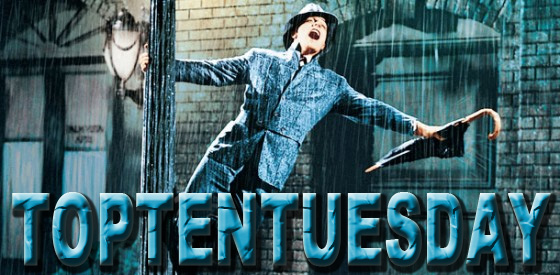
During the “golden age” of Hollywood MGM Studios were the gold standard of movie making specially in musicals. In 1952 they released one of their crown jewels, SINGIN’ IN THE RAIN. After huge success of AN AMERICAN IN PARIS(1951’s Best Picture winner) producer Arthur Freed wished to mount another prestige production with it’s star, Gene Kelly. Freed and composer Nacio Herb Brown decided to utilize songs form the vast studio music library. They brought in Broadway’s Betty Comden and Adolph Green to write a story to link these standards. The duo decided to set the film during the advent of “talkies”. In 1928 many studios were in a panic when Warner Brothers brought sound to the the movies with THE JAZZ SINGER. Comden and Green concocted a loving, hilarious satire of early film making. AFI voted this the 16th funniest film of all time in a recent poll. But then, it’s the performers and musical numbers that cements it as a classic. Freed found two great partners for Kelly: relative newcomer Debbie Reynolds and a song and dance man who could more than keep up with Kelly, Donald O’Connor. How can you pick a favorite sequence? Don Lockwood(Kelly) and Cosmo Brown(O’Connor) rip up a vaudeville stage with “Fit as a Fiddle”. Later they tear up their teacher’s classroom during “Moses Supposes”. Joined by Kathe Selden(Reynolds) they careen over a couch singing “Good Morning”. Lockwood envisions a rags-to-riches fable with “The Broadway Melody” in which his naive hoofer is seduced by the ultimate femme fatale danced by Cyd Charisse(those legs!). Most people believe the greatest scene is Kelly solo on”Singin’ in the Rain” as he joyfully twirls his umbrella and bounces from puddle to puddle after Don has confessed his love for Kathy(aww, he gave that guy his umbrella!). For me, one of the greatest scenes in all cinema is when Cosmo tries to cheer up Don with “Make ‘Em Laugh”. Without the use of movie trickery(CGI was a loooong way off) O’Connor seemingly becomes a cartoon character as he literally dances up walls. You want to turn your frown upside down? Pop in the DVD and go right to this bit of pure magic! The musical stars are greatly helped by some terrific supporting actors. Future movie musical star Rita Moreno(WEST SIDE STORY) is the “Zip” girl. Jerry Lewis movie mainstay Kathleen Freeman(and the “Penguin” in THE BLUES BROTHERS) is a diction coach. Millard Mitchell elicits great laughs as R. F. ,the studio chief. But the real stand put is Jean Hagan In an Oscar nominated performance as the egotistical, dim-witted, screen siren Lita Lamount(the hiss-able villain). Everything about this movie from the sets, costumes, and sparkling cinematography can’t be beat. Some may argue about it’s AFI rating as the number one movie musical of all time, but SINGIN’ IN THE RAIN stands as a testament to the glory of the Hollywood studio produced musical extravaganza! Truly tops in taps!
Yes siree… with so many from which to choose from, it was a difficult list to put together. What would your Top 10 List look like? let us know in the comments section below.
From Sony Pictures and Screen Gems, see BURLESQUE in theaters on November 24, 2010. You can find BURLESQUE on Facebook, on Twitter or visit the official site here.


