BACK TO BLACK – Review

Marisa Abela stars as Amy Winehouse in director Sam Taylor-Johnson’s BACK TO BLACK, a Focus Features release. Credit: Olli Upton/Focus Features

Talented singer/songwriter Amy Winehouse’s tragic life was already the subject of an Oscar-winning documentary, AMY in 2015, made a few years after her death in 2011at age 27 from alcohol poisoning. So my first reaction on hearing of the biopic drama BACK TO BLACK was to wonder if we needed another Amy Winehouse movie. The excellent 2015 documentary seems to have have told her story well and thoroughly, but reportedly the Winehouse family was unhappy with it. However, the family granted permission to the filmmakers of this new biopic drama, BACK TO BLACK, with access to materials and song use.

Director Sam Taylor-Johnson and writer Matt Greenhalgh previously collaborated on another music biopic, NOWHERE BOY, a fine drama about the childhood of John Lennon. The filmmakers assert that the Winehouse family had no say on the final film but the family does come across in a more positive light in this drama and they also have a more prominent role than in the 2015 Oscar-winning documentary.

BACK TO BLACK follows the familiar rise and fall pattern of biopics of other gifted but tragic musicians but does feature some nice acting performances and a chance to hear her songs again. It starts out with young Amy (Marisa Abela) on the verge of her fame, surrounded by her loving, working-class, Jewish family in the Southgate section of London. Amy is talented, and ambitious, and encouraged by her beloved paternal grandmother Nan (Leslie Manville), a still-cool, stylish, former jazz singer, who influenced Amy’s love of jazz and her ’50s-’60s fashion style of beehives, heavy eyeliner, and tight retro dresses. Amy is also funny, strong-willed, out-spoken, hot-tempered and driven. She also already has a big drinking problem.

First off, it is important to mention that the documentary is the much better film, and you will learn much more about the talented but self-destruction Amy Winehouse from it than this biopic. BACK TO BLACK often assumes the audience knows things about Amy Winehouse and her life that they may not, such as her struggles with bulimia, which makes for some confusing or even misleading scenes.

That said, Marisa Abela does a fine job portraying Winehouse, capturing her mannerisms, accent and assertive yet funny persona. The same is also true of the wonderful Lesley Manville as her beloved grandmother Cynthia, whom Amy calls Nan. Eddie Marsan is also very good as her father Mitch, along with Jack O’Connell as Amy’s charismatic, handsome but toxic husband Blake. Juliet Cowan plays Amy’s mother Janis Winehouse, a pharmacist suffering from multiple sclerosis, who raised Amy after separating from her father, and Sam Buchanan as Nick Shymansky, Amy’s friend her became her first manager, but the bulk of the narrative is carried by those first four characters.

The best parts of BACK TO BLACK are the cast’s performances and the chance to hear some of Amy Winehouse’s hit songs. However, the drama assumes that audiences know some things about Winehouse that they may not, and if you want to really learn about Amy Winehouse’s life and career, that Oscar-winning documentary is still the better choice. But you do get more of a feel for her family life and growing up Jewish in London’s Southgate in BACK TO BLACK.

Abela does her own singing and while she does well enough, she is an actress, not a singer, and certainly does not have Amy Winehouse’s distinctive, golden voice. Still, Abela does her best to sing in Winehouse’s style, and is at her most convincing singing the signature “Back to Black.” However, it would have better to have used Amy Winehouse’s real voice, instead of following this craze of actors playing famous singer doing their own singing, often with mixed results, and depriving fans of hearing the real star’s voice, the thing that made them famous.

Abela tries to capture Winehouse’s singing style, and does pretty well, but she is better in capturing Winehouse’s speaking voice, her mannerisms, and gives a convincing and touching portrayal of this funny, demanding, and fascinating talented woman who knew what she wanted and had a deep knowledge and love of jazz.

Lesley Manville is marvelous as Amy’s beloved grandmother Cynthia, a jazz singer who dressed stylishly and influenced Amy’s style and encouraged her musical interest from a young age. The film captures how Winehouse adored her paternal grandmother, whom she called Nan, and depicts Amy as she gets her tattoo paying tribute to her. The other delightful performance is from Eddie Marsan as Amy’s taxi-driver dad Mitch, who had a close loving relationship with his daughter but didn’t always make decisions in her best interests. As Amy’s career soars, dad Mitch is more of an ever-present figure, while mom Janice virtually disappears until late in the film. Mitch had a strong influence and worked closely with his daughter as her career took off, but was not always as good an influence.

Audiences may have some confusion over the relationship between Mitch and Cynthia, as Manville is only 12 years older than Marsan, and they look about the same age. It is easy to assume they are siblings rather than mother and son, and the drama does nothing to clarify this situation, one of the drama’s several problems.

The drama gives a little nod, although not enough, to Winehouse’s skill as a songwriter, and accurately depicts her as a perfectionist in her work, at least until drinking and drugging took their toll. While the bulimia is not directly mentioned until the end, the drama does a better job with her alcoholism, Even before her career really launches, Amy has already had a serious drinking problem, including incidents of seizures. A later scene depicts a confrontation with her manager about going to rehab, with her father siding with his daughter after she promises to cut back, something echoed in the lyrics of her song “Rehab.”

The film is stronger and more focused overall in its first half. The drama starts out fairly well, although it focuses more on Amy’s personal and family life than her career and work. However, it makes a turn into a doomed romance story after Amy meets her future husband Blake Fielder-Civil. The turning point comes after a strong, emotionally powerful sequence where Amy meets Blake. Those scenes are very good, with strong romantic chemistry between Abel and O’Connell, laying the groundwork for the obsessive, toxic love affair that follows. But once Amy falls for Blake, the film becomes increasingly disorganized, jumping around in time and failing to explain several things that pop up. There is a scene where the hard-drinking Amy discovers her new love’s drug problem and firmly rejects and even condemns drug use, yet in almost the next scene, we see Amy buying her own drugs, without Blake, leaving us puzzled as to what happened in between. The film continues to deteriorate in that fashion, ans once Manville’s Nan dies, both Amy and this drama go off the rails, morphing into a film about the toxic romance rather than her music, with Amy repeatedly talk about her longings to be a wife and mother.

Whether Blake was the real villain in Amy Winehouse’s life or not is another matter, as it seems more likely a combination of factors, including Amy’s self-destructive behavior, the loss of a strong hand to steady her with the death of her grandmother Cynthia (reportedly the only person she would listen to when she was out-of-control), a shark-like media, family and friends who failed to intervene to protect or help her, and her drug-addicted husband. But in this drama, the major blame is placed on a drug-addict husband who wanted to hitch his wagon to her rising star.

Although there are a few nice concert scenes after the biopic switches to toxic romance, the film continues to unravel, with several scenes that leave the audience confused about what is going on with the singer. While someone might argue that the film’s narrative falling apart might be meant to mirror Winehouse’s increasingly chaotic life, that explanation doesn’t really hold up. The film continues as a confusing mess until fizzles to a weak ending, with Amy walking away from the camera and seeming on the way to recovery, followed by a black screen and texts telling us of her death from alcohol poisoning at age 27. Then instead of just going to black, there is another scenes with Abela, instead of footage of the actual Amy, saying all she wanted to do was entertain with her songs.

Again, despite the strong performances and warm early scenes with family, you will not really learn much about Amy Winehouse in this biopic drama. Again, the 2015 documentary AMY is the better choice, and a better film overall, where you will learn much more about the massively talented but self-destructive Amy Winehouse.

BACK TO BLACK opens Friday, May 17, in theaters.

RATING: 2 out of 4 stars

LET HIM GO – Review

Diane Lane (left) stars as “Margaret Blackledge” and Kevin Costner (right) stars as “George Blackledge” in director Thomas Bezucha’s LET HIM GO, a Focus Features release. Photo Credit : Kimberley French / Focus Features

LET HIM GO is a Western set in early ’60s Montana, starring Kevin Costner and Diane Lane in a heroic fight, not to save a town as in a classic Western, but to rescue their grandchild. When their son James (Ryan Bruce) dies suddenly, he leaves a hole in the hearts of his parents George (Costner) and Margaret (Lane) Blackledge, as well as a young widow Lorna (Kayli Carter) and infant child named Jimmy. When their daughter-in-law remarries, things change, but then her abusive new husband, Donnie Weboy (Will Brittain), unexpectedly relocates his wife and stepson to join his family in his home state. There was no warning and the young couple left no address yet strong-willed Margaret is determined not to let her grandson go. George, a retired sheriff, tracks them to an area North Dakota. While Donnie’s name rings no bells with George’s law enforcement contacts nor locals in North Dakota, the Weboy names sure does, as a notorious, fearsome family led by a Ma Barker-like matriarch, Blanche Weboy (a fiery Leslie Manville). Despite the unlikelihood of success, Margaret and George aim to bring their grandson back to Montana, and embark on a mission to persuade the Weboys to “let him go.”

LET HIM GO is a bit of fooler, starting out like a polite family drama with fine Oscar-bait cast and settings, a drama about loss and a character study of the older couple – until in the final act, when it transforms into something more like a violent thriller.

Director Thomas Bezucha adapted Larry Watson’s novel of the same name. At first, LET HIM GO builds up a confrontation over child custody, a timeless topic, along with an exploration of the Blackledges’ anguish over possible loss of their lost son’s only child, as much a character study of the two people in this long marriage as anything else.

This drama is set against the sweeping vistas of a Western landscape. It makes for a visually-pleasing, award-minded drama but pretty conventional stuff. But then the film takes an unexpected move, shifting into something else in the final act, when the couple faces the wild Blanche Weboy (Leslie Manville), the fiery matriarch of a violent, powerful family.

LET HIM GO has plenty of visual references to classic Westerns, including those of John Ford, despite to it’s mid-20th century setting. The finely crafted films has gorgeous locations shots (actually shot in Alberta, Canada) that include plenty of big-sky scenery, and lovingly perfect period details in sets and costumes. But what seems like a mild, quiet, thoughtful drama then shakes us up with a sudden turn into crime thriller violence.

It is a jarring but thrilling shift but it makes for an heck of an entertaining film, and one that works on several levels, thanks largely to its sterling cast. That cast is rounded out by Jeffrey Donovan as Blanche’s henchman like younger brother Bill Weboy, and Booboo Stewart as a young Native American hiding out in the North Dakota wilderness, who befriends George and Margaret.

Both aspects of the film – the dramatic exploration of a couple’s sense of loss as their only grandchild, the son of their lost only child, is swept away from them when their daughter-in-law remarries and what happens when they confront the bullying Weboys – are well-crafted Yet taking what seems like a quiet familiar family drama into this dark twist really changes what the film is saying. The exploration of a couple grappling with loss reaches a crisis when determined Margaret decides to track their grandson with a reluctant George in tow, to the home of the domineering matriarch of his stepfather’s family, Blanche Weboy, who declares that the boy “is a Weboy now” and dismisses the pain of the grandparents. But these two are unlikely to go away quietly.

The reversal of the expected pattern of the ex-sheriff leading this pursuit is one of many intriguing aspects of LET HIM GO. The plot is entertaining but what really makes the film cook are the performances. Leslie Manville plays the iron-fisted, gangster-style matriarch of the Weboys, a family known for violence who dominate their little corner of North Dakota. Kevin Costner plays a steely, man-of-few-words retired sheriff, but also a man with a dark view of life. At one point he says life is nothing but a series of losses. He has serious doubts about what they are doing but loyally determined to stand by his beloved wife. Diane Lane plays that wife, a bit of a dreamer, who thinks she can talk anyone into doing things her way, with a confidence in her own charm that sometimes clouds her judgment. Her dreams about how it will all work out aren’t always grounded in reality and it takes her plain-spoken husband to make her see the facts. These flawed but appealing characters are set on doing what they believe they must do, bring their grandson back home to Montana.

The film upends expectations over and over, after building an expectation of the comfortably familiar. The couple look conventional at first but it is Diane Lane’s Margaret who is the strong one, the one driving the quest to reclaim their grandson, while Costner plays the more passive one who goes along, reversing the expected gender roles. It is Margaret who is too focused on her grandson Jimmy to see where she has gone wrong in her relationship with her daughter-in-law.

The wonderful Manville is a glowing menace in a wavy blond wig straight out of classic Nashville country music, who brow beats everyone around her, including her younger brother and three sons. She also dominated every scene she is in, outshining her more famous co-stars. It is a meaty role and Manville feasts on it. Manville’s Blanche is just as determined not to “let him go” as Lane’s Margaret is to take young Jimmy back to Montana with her.

The final showdown lights up the screening in a burst of bracing violence, firing up the audience in a thriller ending worthy of the best of classic drive-in Bs.

LET HIM GO opens in theaters on Nov. 6.

RATING: 3 out of 4 stars

MALEFICENT: MISTRESS OF EVIL – Review

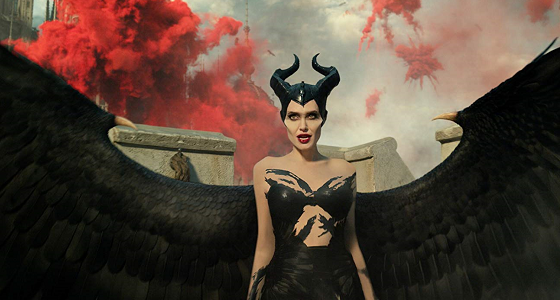
So, whatcha’ gonna’ be for Halloween? You can bet that the Hollywood Studios and the multiplex know that big holiday is charging at us like that headless horseman. The answer to that question, for many young women (and lots of older adults…of both sexes), is “Princess”. Or more specifically “Disney princess”. And what’s essential to that character? Well, other than a prince. A villain, be it a wicked stepmom or sister, evil queen, or witch. About five years ago the “mouse house” had the bright idea (maybe inspired by the big, still-running and touring, Broadway stage smash “Wicked”) to re-imagine, and maybe reform, the villainess from one of their beloved animated classics, but this time with live actors (with a few make-up and CG tweaks). This may have inspired a recent trend in the superhero genre in which the “bad guys” of Spider-Man and Batman were turned into the heroes of their own self-titled features (VENOM definitely, but JOKER is more of an “anti-hero”). Anyway, Disney has finally made a sequel to that unorthodox (then) box office hit, giving it a subtitle that’s closer to her previous “rep”. Lookout, it’s MALEFICENT: MISTRESS OF EVIL.

The beginning of this follow-up more resembles a story by that comic strip icon Snoopy as it’s “a dark and stormy night”. A trio of men is creeping about the enchanted moors. As two are quickly dispatched by shadowy forces, the third scoops up a mushroom-topped imp along with a glowing flower. Both are paid for by a mysterious figure peering out of an opening near the bottom level of a looming nearby castle. The next bright, sunny morning Princess Aurora (Elle Fanning) cavorts with the magical denizens of the Moors including some towering talking trees, a mumbling porcupine lad, assorted plant-like pixies, and a trio of talkative fairies (more like “aunties”), Thistlewit (Juno Temple), Flittle (Lesley Manville), and Knotgrass (Imelda Staunton). Their playful banter is interrupted by Aurora’s suitor, the smitten Prince Phillip (Harris Dickinson). He promptly proposes to her moments before the arrival of his love’s guardian, the supreme sorceress Maleficent (Angelina Jolie). Much to her chagrin, she agrees to meet with Phillip’s parents. After some prepping on human manners and decorum from her crow/pal/familiar Diaval (Sam Riley), Mal and the two kids travel to the kingdom of Ulster for a meet and greet meal with King John (Robert Lindsay) and his Queen, Ingrith (Michelle Pfeiffer). Things don’t go “well”, and Mal takes wing and crashes through a window. As she glides back to the Moors, one of the royals’ (seems they were “prepared”) aides wounds her with an iron-tipped arrow. This sends the injured witch on a journey to find her roots prior to an all-out war on the Moors’ denizens by dark forces within the Ulster castle. But will Aurora side with her fellow human or will she come to the aide of her adopted forest family?

Jolie slips on the horns as though they were a comfy old pair of jeans (or…slippers). She still gives the witch a sexy diva quality, rolling her eyes and caressing every bit of dialogue for comic effect. that’s not to say she exudes no real menace. With the new look via makeup and costuming I wondered which was sharper, those horns, her molars, her collarbones (impressive), or her acid-tinged line delivery. Luckily she’s got a formidable adversary in Pfeiffer, all dead-eyed stares and raised brows as the plotting queen (insert mother-in-law from “you know where” jokes here). She bounces between passive-aggressive matriarch to campy screeching royal harpy, all while looking stunning in a series of jeweled gowns. The inspired match-up harkens back to Shirley MacLaine versus Anne Bancroft in THE TURNING POINT or maybe further back to Joan vs. Bette in WHATEVER HAPPENED TO BABY JANE. Fanning rarely gets to join in on the farce fun this time out as she carries much of the emotional drama as the conflicted princess, though she throws herself into the final act’s big battle sequences. Dickinson’s Phillip spends most of his time longingly gazing at her until he gets “woke’ to the “sitch”, while Lindsay as his papa, the King is an ineffectual pawn. Riley provides just a bit of comic relief as the man-crow, as does Temple, Manville, and Staunton as the flitting fairies whose oversized human heads on tiny bodies have an oft-putting quality like Funco Pop hummingbird girls. As for the actors playing new (to the series) roles, Chiwetel Ejiofor as Conall makes soulful eye contact with Mal as he mainly provides her with ancestry info in a missed opportunity for an engaging romantic subplot. This as Ed Skrein bares his fangs and six-pack abs as the “ready to rumble” Borra.

Despite the opportunity for a frenetic funny “throw down” between the two screen glamour goddesses, director Joachim Ronning struggles to keep the pace consistent and make the action sequences coherent. It doesn’t help that the three writer credited script changes tone from sprightly sparkly fairy tale to origin story (an island with denizens resembling the children of the Na’vi from Pandora in AVATAR and the Hawk People of FLASH GORDON minus the great Queen score), and a seemingly never-ending war between then modern weapons and magic. There are noble sacrifices aplenty (with actors perhaps happy to sit out a third outing), but most viewers will spot a trite character resurrection long before the glowing spell begins. By this time even the most devoted Disney kids and their folks will be worn down. Visually the costumes are eye-popping, but the opening Moors in the morning backgrounds are a candy-coated CGI overload, packed with lots of future toy “merch” (some critters seem to pop up only to justify a new “product”). Though she’s still one of the greatest Disney villains, her second live-action (mainly) flick, MALEFICENT: MISTRESS OF EVIL, fizzles and fumbles rather than flies. Hang them horns up already.

2 Out of 4